
Evidence Review
Youth Employment in Central Asia
Who is excluded, what the evidence says works, and what to test first
Geographic focus: Kazakhstan, Kyrgyzstan, Tajikistan, Uzbekistan
Type: Evidence review
Methodology: Structured search of statistics, evaluations and research in English and Russian, 2016 to 2026; 127 sources screened, 37 included
Focus areas: Youth employment, young women outside the labour force, programme design
In all four countries young women are more likely than young men to be out of work and education: more than one and a half times as likely in Kazakhstan, more than twice in Kyrgyzstan and three times in Tajikistan. Where the data allow a closer look, this exclusion is mostly not unemployment. In Tajikistan’s 2025 labour force survey, 64% of women aged 20 to 24 are neither working nor studying, against 14% of men. Across the 15 to 24 age group, at least 85% of those out of work and education are outside the labour force altogether. The programme types reviewed here, training with work experience, apprenticeships and job matching, are designed for people who are in it.
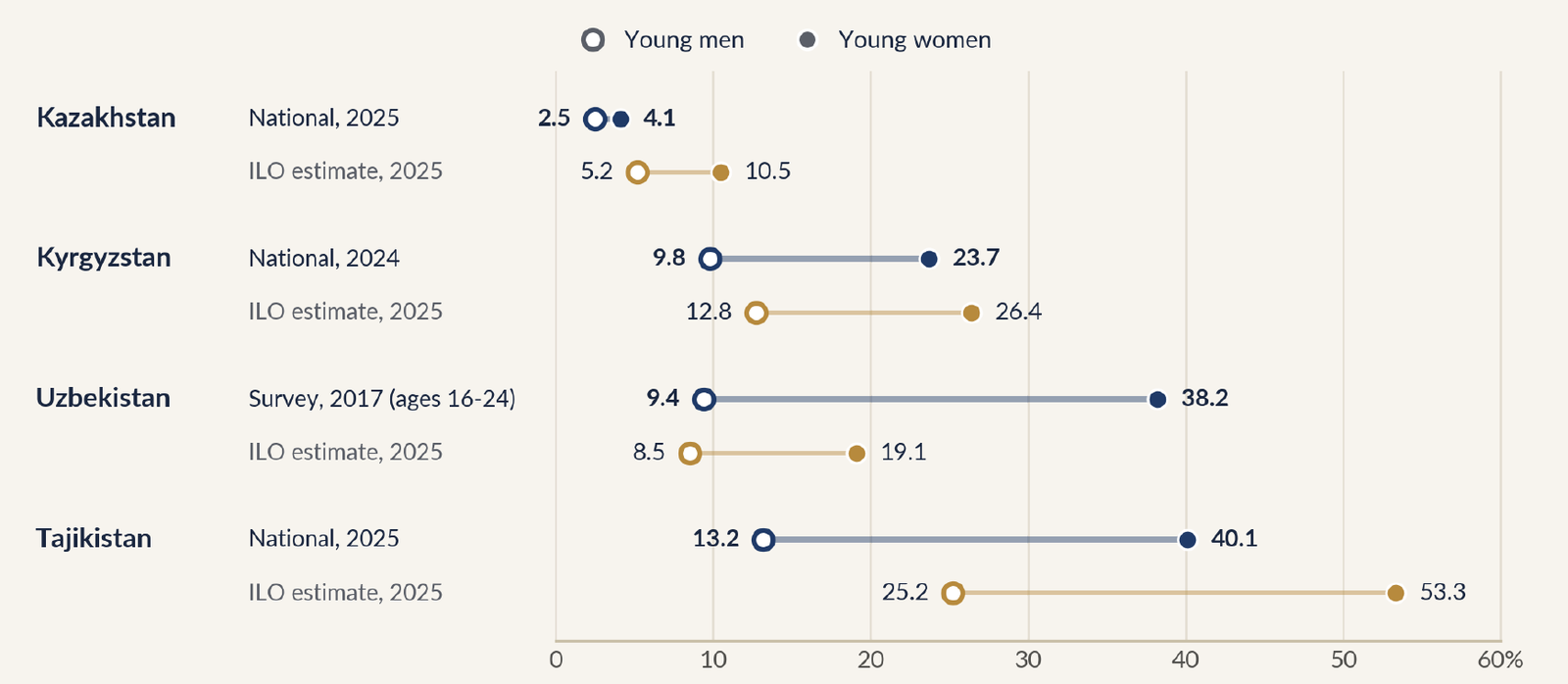
Youth NEET rate by sex, national surveys and ILO modelled estimates (%).
Sources: surveys of Kazakhstan (2025), Kyrgyzstan (2024) and Tajikistan (2025); Uzbekistan Household Budget Survey 2017 as analysed by the World Bank; ILO modelled estimates, ILOSTAT. Ages 15 to 24 unless stated.
What it means for funders
- Decide who the programme is for before choosing the instrument. A scheme for unemployed graduates in Kazakhstan and one for rural young women in Tajikistan are different undertakings, and the evidence reviewed here speaks mainly to the first.
- Favour designs that tie training to an employer and last several months. Across the reviews, that is the design feature with the most consistent support.
- Build a comparison group into what is funded. We identified one impact evaluation of a youth programme in the four countries. The rest of the regional evidence reports how many participants found work, which does not show how many found work because of the programme.
- Plan on national survey figures, and check them. The internationally published estimates differ from each country’s own statistics by up to thirteen percentage points. The review sets the two side by side.
Where to start
If one thing is to be tested first, our view is that it should be employer-linked training in Kyrgyzstan or Kazakhstan. Separately, and with more urgency, Tajikistan needs diagnostic work on young women outside the labour force, because no programme choice for that group is yet supported by evidence. The review proposes a first step for each of the four countries.
Inside the review
- The scale and shape of youth exclusion, with national and international figures side by side
- What works: three families of programmes, rated for strength of evidence and fit with Central Asian labour markets
- Implications for programme design, with next steps by country
- What the review leaves open
Target Research carries out evidence reviews and evaluations for development programmes and other organisations working in the region. To discuss a review on another question, or one of the first steps this review proposes, write to office@target-research.org.