
Target Trajectory Monitor (TTM)
Monthly political and strategic intelligence on Central Asia.
TTM is a monthly analytical publication that tracks political, governance, security, and connectivity dynamics across all five Central Asian states.
It focuses on trajectories — identifying what the current moment signals about the direction of travel in each country and across the region, and why it matters.
Structure of each issue
I. Regional Trajectory
The overarching read on where the region is heading and what the current moment means in terms of political direction, external pressures, and structural trends.
II. Signals in Focus
Selected developments from the month that carry analytical weight — chosen for what they reveal about underlying dynamics.
III. Risks to Watch
Forward-looking and specific: the signals, decisions, and pressure points that may shape the coming weeks and months.
IV. Analytical Note
A deeper analytical observation — a pattern, historical parallel, or structural argument that shapes how the region should be read.
Who it is for
- Diplomatic and foreign policy staff
- International organisation officials
- Development practitioners
- Security analysts and researchers
- Investors and private sector professionals
What makes TTM different
- Focuses on trajectories, not headlines
- Covers all five Central Asian states
- Combines regional and country-level analysis
- Identifies emerging risks and opportunities
- Uses a consistent analytical framework
Produced by Target Research, with editorial direction provided by Dr. Shairbek Juraev.
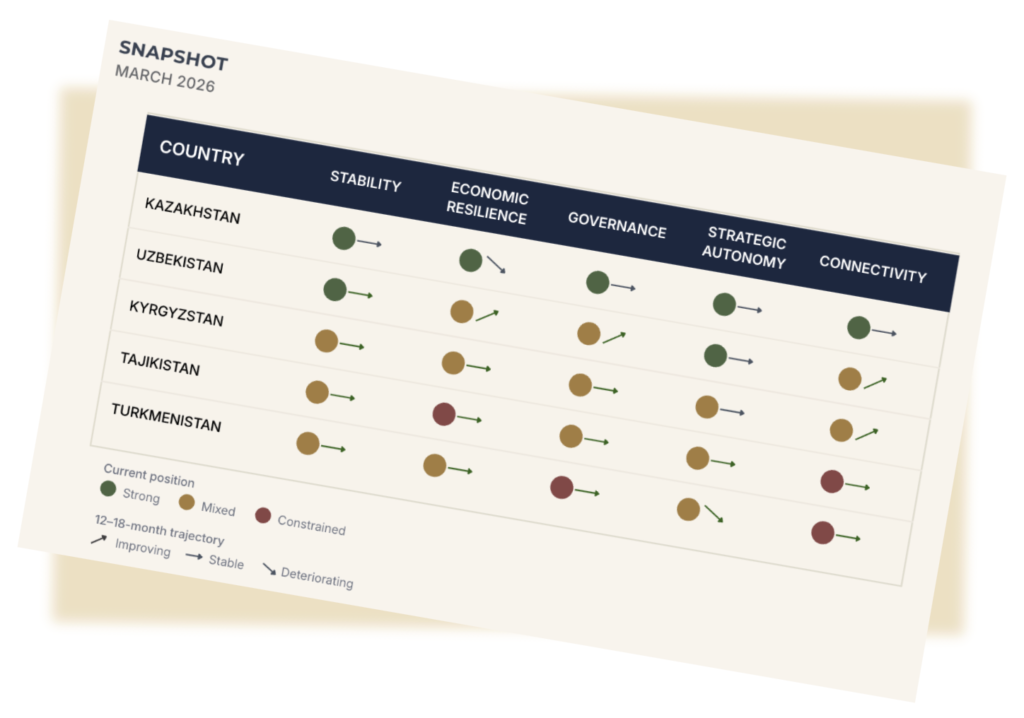
Understanding the TTM matrix
The TTM matrix combines structured expert assessment with ongoing monitoring of political, economic, and geopolitical developments. It is not a numerical index. It is designed to provide a compact comparative reading of current position and likely trajectory over the next 12–18 months.
Stability
Likelihood that the political system can maintain continuity and avoid major disruptive shocks.
Economic Resilience
Ability to absorb economic shocks and maintain macroeconomic and social stability.
Governance
Effectiveness and predictability of state institutions and decision-making structures.
Strategic Autonomy
Ability to pursue national priorities without excessive dependence on external actors.
Connectivity
Access to regional and global markets through transport, trade, energy, and digital networks.
Colour indicates current position: Strong, Mixed, or Constrained.
Arrow indicates likely 12–18-month trajectory: Improving, Stable, or Deteriorating.
Past Issues
Previous issues of Target Trajectory Monitor. Regular monthly publication began in June 2026; March was a pilot issue.
Sep 2026
Past issue
Governments committed to nuclear power, rail, gas markets and data platforms; August exposed the gap between commitments and delivery.
Download PDFAug 2026
Past issue
Kyrgyzstan’s scramble for fuel, the drone strikes cutting Kazakh production, labour migration to Russia falling, and a treaty map that closed before the alternatives could open.
Download PDFJul 2026
Past issue
Kazakhstan’s political redesign, Russia’s fuel shock reaching the region, Rogun’s multilateral turn, and the financial enclaves multiplying ahead of the investors they court.
Download PDFJun 2026
Past issue
The region’s nuclear lock-in taking shape, Uzbekistan’s London IPO, China’s deepening security ties with Tajikistan, and a Middle Corridor tested against the limits of its capacity.
Download PDFMar 2026
Pilot issue
Inaugural issue introducing the TTM framework, the five assessment dimensions, and the baseline reading of regional and country trajectories across all five Central Asian states.
Download PDFReceive TTM by email
Enter your email to receive future issues directly in your inbox.
After submitting the form, you should briefly see a confirmation message on this page. If no confirmation appears, please email office@target-research.org with “TTM signup” in the subject.