
Political Control Tightens in Central Asia
The space for dissent is narrowing, while presidential offices in Kyrgyzstan and Uzbekistan are extending their authority over ministries and public services. Growth remains strong, but its supports, from dollar access to migrant earnings and gas supplies, depend on decisions made outside the region.
Key judgements
- Consolidation is likely to continue over the coming year, beginning with Kyrgyzstan’s January presidential election against a narrowed field.
- Kyrgyz compliance has yet to remove the risk to dollar access; migrant earnings face tighter Russian work rules and narrowing payment routes.
- Kazakhstan’s gas shortfall points to sustained higher dependence on Russia, both as supplier and as processor of Kazakh gas.
The assessment in brief
Power in Central Asia has long sat with the presidency. September and early October added a cluster of further steps in the same direction, by different routes.
Kazakhstan’s new constitution replaced the two-chamber parliament with a single Kurultai. It has five parties, and observers found that every party contesting the August election supported the president’s policies. Kyrgyzstan, long the region’s outlier, is closing the gap. Laws on false information, foreign-funded NGOs and media registration have raised the cost of independent reporting, and the Presidential Affairs Office is absorbing ministry functions and state companies ahead of a 27 January election that is unlikely to be seriously contested. In Uzbekistan a constitutional law in force since 14 August lets the Head of the Presidential Administration issue orders binding on all state bodies, and its officials have lifelong immunity from criminal prosecution. In Tajikistan the lower house voted to stop applying the Rome Statute.
The less visible shift is inside the state: the president’s own apparatus is taking on the work of government. Western partners still criticise election conduct and political trials, but the criticism tends to arrive alongside offers of closer ties. We expect consolidation to continue over the coming year. The full issue sets out what would change that judgement.
Trajectory Snapshot, October 2026
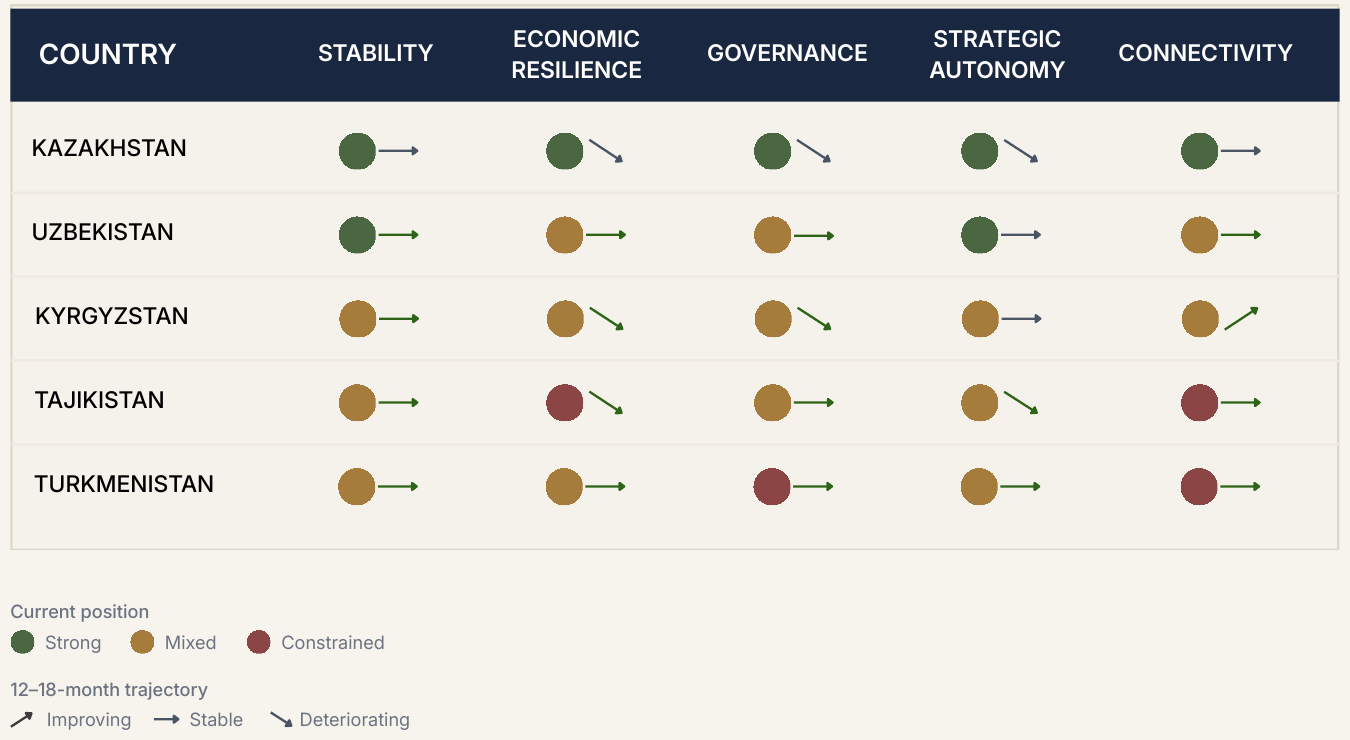
- Kazakhstan, strategic autonomy: stable to deteriorating. About 9 billion m³ of Russian gas is under discussion for 2027, more than twice the 2025 volume.
- Uzbekistan, governance: improving to stable. The Presidential Administration’s new binding authority leaves the direction of government effectiveness unclear.
- Kyrgyzstan, governance: stable to deteriorating. Operating rules are becoming less predictable as the Presidential Affairs Office absorbs state assets and administrative functions.
Positions unchanged. All scores since March: Central Asia Trajectory Tracker →
Also in the full issue
Kyrgyzstan Tightens Compliance as Dollar Access Remains at Risk
Kyrgyz state banks have closed the accounts of more than 220 companies over sanctions risks, and the UK has listed a payments company owned by the Finance Ministry.
Get the full issue →Kazakhstan’s Gas Shortfall Points to Sustained Higher Imports from Russia
About 11 billion m³ in 2026, against about 4 billion m³ in 2025.
Get the full issue →Migrant Income Is Under Pressure, Most of All in Kyrgyzstan and Tajikistan
Russia will tie Tajik and Uzbek work patents to tax-reported income from 2027.
Get the full issue →What Is Driving Kyrgyz Growth?
The economy grew 11 per cent in the first eight months of 2026. We look at what pays for it and what it is building.
Get the full issue →Winter Energy · Russian Diesel · Kazakh Household Debt
Three risks with tests due this winter, each with its triggers.
Get the full issue →Trajectory Check, Month in Review, Month Ahead
How last month’s calls held up, and the dates that matter in November.
Get the full issue →Read the full October issue
Sign up to receive the Target Trajectory Monitor by email, starting with the October issue.